
Nimzowitsch-Larsen Attack
White plays the b-pawn one square forward so the queen’s bishop can go to b2. From there it looks diagonally across the whole board at Black’s side. You let Black put pawns in the middle, then attack them with pieces instead of racing pawn for pawn.
- Play as White
- 700–1800 Elo
- Hypermodern
- Positional
Nimzowitsch-Larsen Attack
Modern Variation
On this page
- What it is
- White moves the b-pawn one square (1.b3) so the queen’s bishop can take the long diagonal from b2.
- What it is for
- Letting Black build a big pawn centre, then attacking it with pieces instead of pawns.
- Who it suits
- Players who would rather learn one set-up than five different move orders.
- What it costs
- White gives up the fight for the centre on move one and plays for a slower, quieter edge.
Overview
How do you play the Nimzowitsch-Larsen Attack?
This is a hypermodern opening. Hypermodern means you do not try to own the middle of the board with your own pawns: you let the opponent put pawns there and then hit them with pieces from a distance. In practice White makes three quiet moves, the b-pawn forward, the bishop to b2 and the e-pawn forward, and gets the same comfortable position against almost anything Black does.
| First move | 1.b3 |
|---|---|
| ECO | A01 |
| Named after | Aron Nimzowitsch and Bent Larsen |
| Played as | White |
Why not put a pawn in the centre on move one?
Most first moves claim the middle of the board straight away. After 1.e4 the pawn stands on a central square, attacks two more, and opens lines for the queen and a bishop. It is a good move, and it also commits White before Black has said anything.
1.b3 does something quieter. The pawn steps one square so the bishop behind it can come out to b2, where it looks diagonally across the board at the squares Black wants to use. Nothing is claimed yet and nothing is committed: Black is invited to build a centre first.
The usual way: a pawn takes the centre
After 1.e4 the pawn stands in the middle and attacks d5 and f5. Strong, and it tells Black at once what kind of game this will be.
This way: the bishop gets the diagonal
After 1.b3 nothing is claimed in the middle yet. The green arrow shows why the pawn moved: the bishop comes to b2 next and watches the centre from there.
Which three moves do you start with?
Move the b-pawn one square (1.b3), put the queen’s bishop on b2 behind it (2.Bb2), then move the e-pawn one square (3.e3). All five lines on this page begin that way, whatever Black has replied, which is the practical reason to choose this opening: one set-up to learn instead of a different answer to every defence.
Your fourth move is the first real decision, and it depends on what Black put in the middle. If Black has a pawn on e5 defended by a knight on c6, your light-squared bishop goes to b5 and pins that knight. If Black has a pawn on d5 instead, the same bishop does the same job one move later.
The set-up, and the first real choice
b3, Bb2, e3. The green arrow is move four: with e2 empty the bishop can reach b5 and pin the knight on c6.
Why let Black take the centre?
Pawns in the middle are strong while something is defending them and a burden when nothing is. Every extra pawn Black pushes forward is one more square that needs a piece watching it, and those pieces are exactly what you trade off.
That is the trade this opening is built around: your light-squared bishop for the knight on c6. Giving a bishop for a knight sounds like a bad deal. Here it is not, because that knight is usually the only piece holding the centre together, and when Black takes back with the b-pawn the pawns on c6 and c7 end up on the same file, where they can never be repaired.
What the trade leaves behind
Black has taken back with the b-pawn, so c6 and c7 sit on one file. The knight that guarded e5 is gone, and the bishop on b2 and the knight on f3 both hit the pawn.
Is it any good?
Is 1.b3 a serious opening?
Yes, with a caveat worth saying plainly. It is a sound first move that has been played at the top level. Larsen made it his own, Nimzowitsch played it long before that, and it has never needed refuting.
The caveat: it does not fight for an opening advantage the way 1.e4 and 1.d4 do. What it offers instead is a position White understands better than the opponent does, reached without memorising theory. Below master level that is often worth more than a half-pawn edge on move twelve.
Who it is for
Who should play 1.b3?
The Nimzowitsch-Larsen asks for patience and gives back simplicity. That trade suits some players and not others.
It fits you if
- You would rather learn one setup than a different answer to every defence.
- You are comfortable in slower positions where the plan matters more than the next tactic.
- You want to spend study time on ideas rather than on move orders.
- You keep meeting openings you have not prepared for and want to stop being surprised.
It does not fit you if
- You want a forcing advantage out of the opening.
- You dislike giving the opponent space early, even when it is on purpose.
- You prefer positions that resolve quickly into tactics.
Your games
Start with the openings you actually play
Connect Chess.com or Lichess and My Training reads your recent games, then puts the openings you actually play at the top of the catalogue.


Core ideas
What is White actually trying to do?
Learn these three and most of the moves follow on their own. The order matters: bishop first, trade second, pawns last.
The bishop before the pawns
Your first decision is where the queen’s bishop will live, not where the pawns go. From b2 it watches the two central dark squares, e5 and d4, and no black pawn can ever attack b2, so it stays there all game.
Remove what defends the centre
The knight on c6 is usually the piece holding Black’s centre together. Your light-squared bishop goes to b5 and attacks it along the diagonal towards the black king, so it cannot step away, and then you take it. A bishop for a knight is a fair price when that knight is the only thing keeping the centre standing.
Pawns last, and only where they help
Castle first, then move the d-pawn to d3 so it guards e4. Without that guard Black pushes a pawn to e4 and blocks your bishop on b2 out of the game; with it, you can simply take. Only then does the last knight come to d2, heading for c4, where it attacks both the pawn on e5 and the bishop on d6.
Typical plans
What is your plan once the pieces are out?
One position seen from both sides. This is the tabiya the deepest training block reaches, a tabiya being a standard position an opening keeps arriving at. From here each side has a clear job.
White’s plan
White: pressure, then the queenside
Both white bishops look through the centre, the knights have c4 and f3 to go to, and the two black pawns stacked on the c-file cannot be repaired. White plays wherever those weaknesses are, not to a timetable.
- Keep three pieces pointed at the pawn on e5: the bishop on b2, the knight on f3, and the knight on d2 once it reaches c4.
- Hold the e4 square with the pawn on d3, and take if Black pushes there anyway.
- Play on the queenside, where the two black pawns on the c-file cannot advance without leaving a weakness.
- Open the bishop’s diagonal by trading pawns in the centre, not by pushing past them.
Black’s plan
Black: hold the centre, free the pieces
Black has more pawns in the middle and needs them to count. The way to do that is to push the e-pawn one more square, usually after bringing the f-pawn up to support it. Every square those pawns want is a square the white pawn on d3 and the two knights are already watching.
- Push the extra central pawn to e4, usually after supporting it with the f-pawn.
- Find a job for the bishop on c8, which the doubled pawns leave short of squares.
- Use the b-file, opened when Black took back on c6 with the b-pawn.
- Keep the pawns in the centre: here they are Black’s one real asset.
What Black plays
What do you do against Black’s main answers?
Black can reply in any way, and the same three set-up moves meet all of them. Here are the three answers you train first, with how often each appears in games between players rated 1000–1799 (Lichess opening explorer, blitz and rapid, 29.9 million games after 1.b3, August 2026).
1…e5: 40%
Black puts a pawn on exactly the square your bishop is aimed at. You move the e-pawn up one square, then bring the light-squared bishop to b5 to pin the knight defending that pawn and trade it off.
1…d5: 25%
A piece cannot chase a pawn off d5, so you do not try. The bishop watches the dark squares beside it instead, and the same trade on c6 arrives a move later.
1…Nf6: 7%
Black develops first and usually follows with the g-pawn, putting a bishop on g7. Both sides now have a bishop on a long diagonal, and the game turns on who opens theirs first.
Main line
What does a full opening look like, move by move?
The Modern Variation against 1…e5, nine moves deep. This is the deepest block in the training. Pick any move to see the position and what that move is for.
- 1.
- 2.
- 3.
- 4.
- 5.
- 6.
- 7.
- 8.
- 9.
Before the first move. White is about to decide where the queen’s bishop lives before deciding anything about the centre. That is the whole opening in one sentence.
You’ve seen the main line. Now train the key French Defense positions yourself.
Variations
Which answers from Black will you actually meet?
Black picks the variation, not you, so each is named after Black’s first move: 1…e5, 1…d5, 1…Nf6, 1…e6 and 1…c5. Every one of them can be trained today. Shares come from the Lichess opening explorer (1000–1799, blitz and rapid, August 2026).
Modern Variation
Black answers 1…e5, the reply the b2 bishop was placed for. White plays e3 and Bb5 to remove the knight that defends the pawn.
Classical Variation
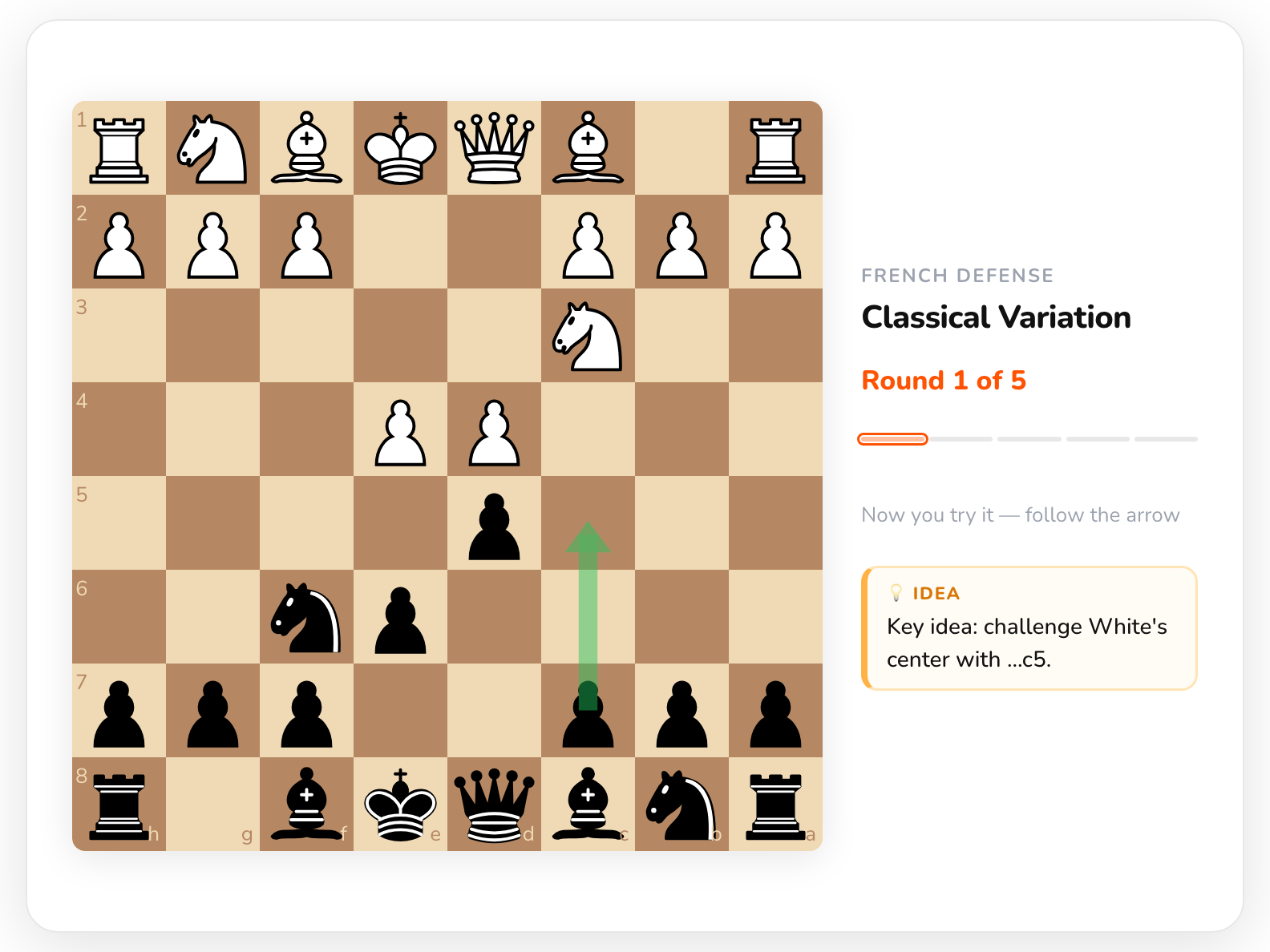
Black builds with 1…d5 and a knight on f6. The pawn cannot be chased, so White targets the pieces around it instead.
Indian Variation
Black develops with 1…Nf6 and fianchettoes in reply. Two bishops face each other down the long diagonal and neither can be chased away.
Solid centre with 1…e6
Black supports ...d5 before playing it. The centre is harder to hit, so White develops and waits for the moment to trade on c6.
English Variation
Black answers 1…c5 and takes the dark squares the bishop wants. White finishes the setup and challenges with d4 later.
Common mistakes
Which mistakes do beginners make in this opening?
All three come from forgetting what the bishop is for. Each board below shows the exact position where the mistake is possible, with the losing move drawn in red.
Taking the pawn on e5
The bishop can capture on e5 and it loses a piece: the knight on c6 recaptures and White has given a bishop for a pawn. The bishop is there to press the pawn, not to win it.
Retreating the bishop after ...a6
When Black kicks the bishop with ...a6, moving it again spends a tempo on a piece White was going to trade anyway. Take on c6 instead. That was the plan before ...a6 was played.
Retreating the knight the wrong way
After Black plays ...e4 the knight on f3 has to move, and only d2 keeps it doing something: from there it attacks the pawn that just advanced. e1 and g5 both walk away from the game.
Compared with
Should you play 1.b3 or the Réti?
Both are hypermodern first moves that leave the centre alone, and they are often considered together. The difference is which piece does the pressing.
| Nimzowitsch-Larsen (1.b3) | Réti (1.Nf3) | |
|---|---|---|
| First commitment | The queen’s bishop, before anything else. | A knight, keeping every pawn option open. |
| Main pressure | The b2 bishop on the long diagonal. | Pawns on c4 and g2 with the bishop behind them. |
| Theory to learn | One setup against every reply. | Several, because the move order transposes widely. |
| Transpositions | Rare. The position stays its own. | Common: into the English, the Catalan and queen’s-pawn openings. |
| Suits | Players who want one plan they understand. | Players comfortable steering between systems. |
If you like the idea of a fianchettoed bishop but would rather not learn where the game can transpose to, 1.b3 is the simpler of the two.
How to learn it
How do you remember it and use it in games?
The training is built in levels, and four are ready. Each level asks you for the moves of one line until you can find them yourself, so what you remember is the decision, not a list. That is enough to play this opening against everything Black commonly tries; deeper levels are still being written.
Start with the setup
The b-pawn forward, the bishop to b2, the e-pawn forward. The same three in all five lines here, so you reach a position you know without spending the first minutes of the game working out what to play.
Learn the trade
Bring the light-squared bishop to b5 to pin the knight that defends the centre, then take it. This one idea turns a quiet set-up into a plan.
Then add the replies
Take the five answers one at a time. They all share the same first three moves, so every new one costs far less to learn than the first.
Understand the opening. Don’t just memorise moves.
Understand the idea behind each move, then train it until you can find the right decisions in your own games.
FAQ
Questions about 1.b3
Starting out
Is the Nimzowitsch-Larsen Attack good for beginners?
It is one of the better first moves to start with, because there is one setup to learn instead of a different answer to each defence. The trade-off is that you will not get an advantage out of the opening: you get a position you understand.
How much theory do I need?
Three moves to begin: b3, Bb2, e3. After that you need the idea of trading the bishop for the knight that defends the centre, and one plan for each of Black’s five common replies.
What rating is it good for?
The training is written for roughly 700–1800 online. Below that the set-up is still perfectly playable. Above it you start meeting opponents who know how to use the extra central pawn, and the lines need more depth than four levels give.
Playing it
Why give up the bishop for a knight?
Because that knight is usually the only piece holding Black’s centre together. Once it is gone, the central pawn has fewer defenders than attackers. In the main line Black also has to take back with the b-pawn, which leaves two pawns stuck on the c-file where they can never be repaired.
What if Black just ignores me and develops?
Then you get the setup for free. b3, Bb2 and e3 are useful against every arrangement, so a quiet reply from Black means you reach your position without having to fight for it.
Should I ever take on e5 with the bishop?
No. A knight on c6 recaptures and you have given a bishop for a pawn. The bishop is there to press the pawn and make Black defend it, not to win it.
When do I play d4?
Usually not early. A pawn on d4 stands on your own bishop’s diagonal and blocks it. Where this move does belong, it comes after the pieces are developed and after you can see how the bishop gets back into the game once the diagonal opens again.
In context
Is 1.b3 played at a high level?
Yes. Bent Larsen played it regularly in the 1960s and 70s and it carries his name alongside Nimzowitsch’s; it still appears in grandmaster practice, usually as a way to avoid preparation rather than to claim an advantage.
How is it different from the Réti?
The Réti starts with a knight and keeps the pawn moves open, which means it transposes into other openings constantly. 1.b3 commits the bishop first and stays its own game: less to learn, less flexibility.
About this guide. Written from the positions the trainer actually teaches. Every frequency comes from the Lichess opening explorer (1000–1799, blitz and rapid, August 2026) and is quoted with its date. Nothing on this page is estimated. Last updated 31 July 2026.