
How Many Chess Opening Moves Should a Beginner Learn?
You do not need to memorise a 15- or 20-move line to start. Learn a small first layer, understand why the moves are played, then go deeper when the positions you already know stop being enough.
Quick answer
For a beginner, about the first five moves of one main line is a practical place to start. But do not use move count as the finish line. Before learning more, make sure you can recognise the position, explain what your move does, understand the replies you meet, and know the basic plan that comes next.
Why counting moves stops working
An opening is not one straight sequence. Your opponent chooses too.
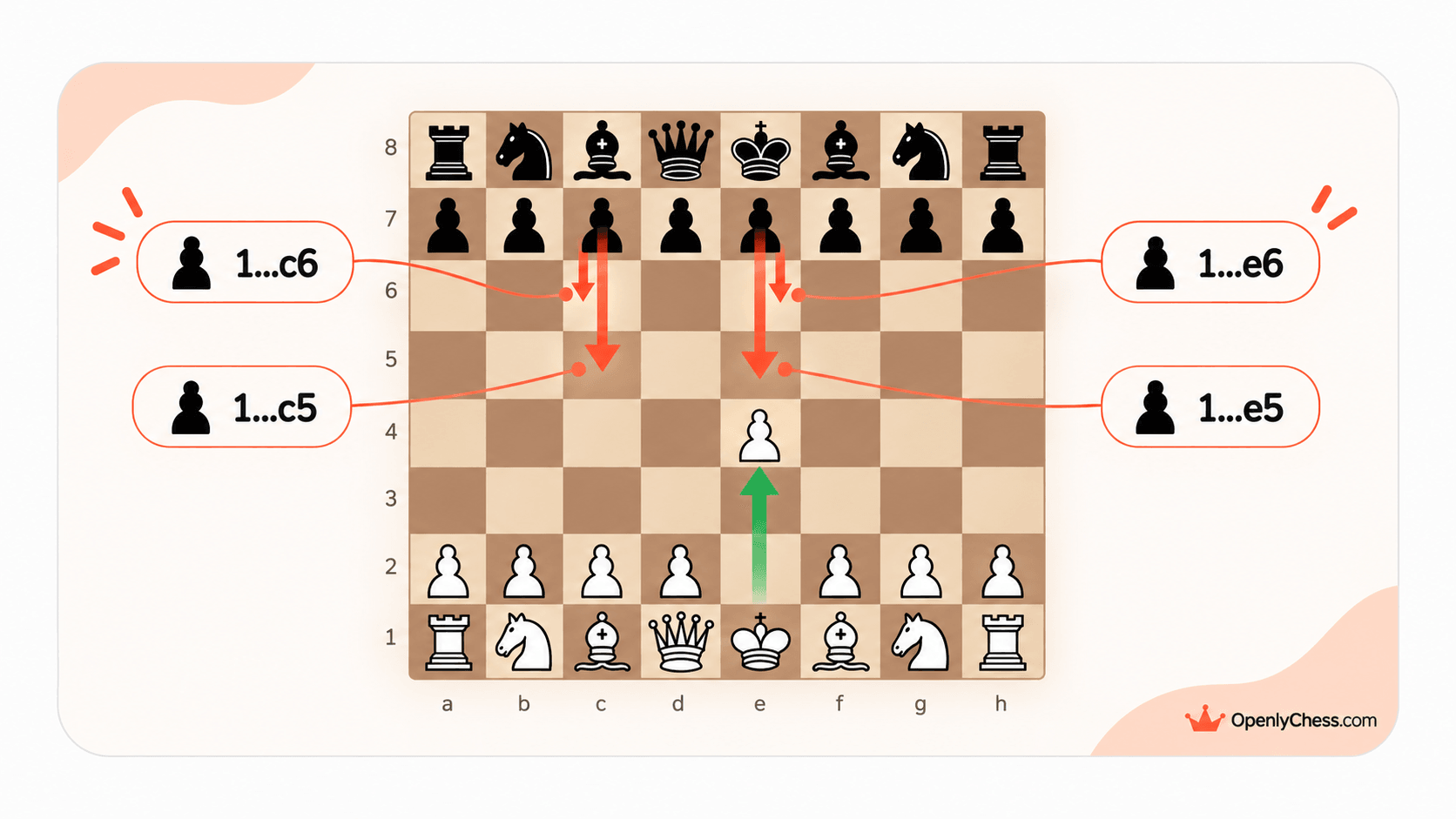
After 1.e4, Black has many possible replies. Here are four examples. Each one changes the position and the plan, so learning “five moves” quickly becomes learning several different decisions.
Green — White’s move · Red — Black’s reply · Light red — next plan · Target — what the move attacks
1…e5 — Open Games
Examples: Italian GameRuy López
Black moves the pawn from e7 to e5 and takes space in the centre opposite White’s pawn on e4. White’s pawn cannot move forward to e5 anymore.
Black moves the pawn from c7 to c5. From c5 it controls d4, where White can place a second central pawn. Black fights for the centre from the side instead of putting a pawn directly opposite e4.
Black moves the pawn from e7 to e6. The next plan is to move the pawn from d7 to d5 and challenge White’s pawn on e4 with another pawn.
Black moves the pawn from c7 to c6. The next plan is also to move the pawn from d7 to d5 and challenge White’s pawn on e4. Because the pawn on e7 stays where it is, the bishop on c8 has more room to come out later.
Two moves later, each of those has forked again.
So counting to twenty moves along one path tells you nothing about the path your opponent actually chose — and in real games they leave the main line early and often. What you can count instead is positions.
Counting moves
“I know eight moves of this opening.”
Knowing the position
“I recognize the position, understand my move and know what I want to do next.”
These four replies lead to very different opening positions. We’ll use one of them — 1…e6, the French Defense — to see why understanding the idea is more useful than memorising a move number.
Example: the French Defense
Two more moves down that branch, after 1.e4 e6 2.d4 d5 3.e5, the position looks like this. Black is to move.
White’s pawn on d4 supports the advanced pawn on e5. Black moves the pawn from c7 to c5 to attack that base of the pawn chain and challenge White’s centre.
That sentence is the difference between knowing a move and knowing a position. “3…c5” is a fact you can forget by Thursday. “The pawn on e5 is held up by the pawn on d4, so hit d4” is a reason — and a reason survives a change in move order, which is exactly what happens when your opponent plays the same idea two moves later than the book does.
Understand the opening. Don’t just memorise moves.
Understand the idea behind each move, then train it until you can find the right decisions in your own games.
Choose an opening →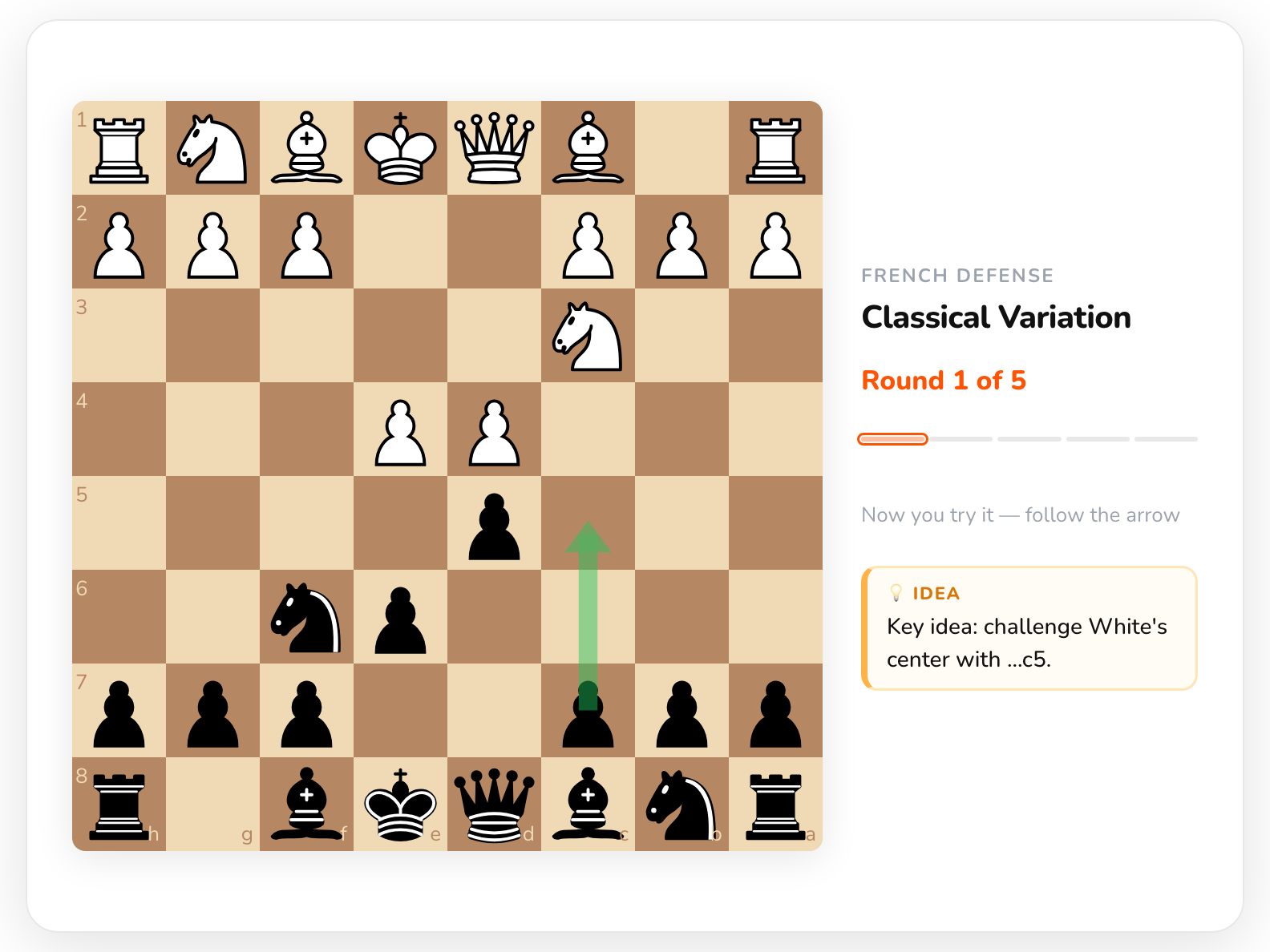
Start with about five moves, then learn positions
Five moves is a good first layer, and roughly what beginner study plans recommend: Chess.com’s beginner opening plan asks players to memorize the first five moves of the openings they intend to play. Its plan for intermediate players raises that to seven to ten — which tells you something on its own. Depth is grown into, not started with.
Five moves is enough to leave the opening with a normal position: a pawn or two in the centre, a couple of pieces out, a king you can castle. That is all the opening owes you.
The mistake is not learning too few moves. It is learning the sixth and seventh while the first five are still guesswork — a long line you half-remember loses to a short one you actually know.
What to know before learning more
Four things, and none of them is a number. If one is missing, another five moves will not help.
Recognize the position
You have seen this arrangement before and know which opening you are in — however you arrived at it.
Understand what your move does
One sentence: it attacks something, defends something, clears a path for one of your pieces, or takes a square away from your opponent.
Know the common replies
Not every reply. The two or three you actually keep meeting in your own games.
Know the basic plan afterwards
Which side of the board you play on, which pawn you want to push next, where your worst piece is going.
When to go deeper
Not on a schedule, and not because a number feels low. Go deeper when one of these is true:
- The position keeps coming up. You reach it often enough that the time will pay back.
- The same reply keeps causing trouble. One specific answer is where your games go wrong. That is a gap with an address.
- One wrong move loses material on the spot. A few positions are that sharp, and those you do have to know by heart. They are rarer than people think, so find them in your own games rather than assuming they are everywhere.
- What you already have is solid. You reproduce the current positions without effort. Then the next five moves are the cheapest improvement available.
Four yeses and you have earned the next layer. Anything less, and the next layer is where you will forget it.
How this works in practice
OpenlyChess is built around this idea: learn an opening as a sequence of positions and decisions, understand the purpose of the move, practise it on the board, and later reproduce it from memory.
So pick one opening you like the look of, learn about five moves of it, and play those five until the position is familiar. The next five will be waiting.
Which opening should you learn first?
You do not have to pick one at random. If you already play on Chess.com or Lichess, the more useful question is which positions actually come up in your own games.
In short
Do not measure opening knowledge only in moves. Start small — about five moves of one line you intend to play — and deepen when the next unfamiliar position becomes the real problem. That moment arrives on its own, in your own games, and it teaches better than a number.
Common questions
Is five opening moves enough for a beginner?
Five moves of one main line is a practical starting point. Go deeper when you start reaching positions you no longer recognise or understand.
Should beginners memorise long opening lines?
Usually no. It is more useful to understand what each move does, what replies you are likely to face, and what plan comes next.
When should I learn more opening theory?
Learn more when the positions you already know stop being enough in your real games.
How many openings should a beginner learn?
Start with a small repertoire: one opening plan for White and a simple answer to the first moves you face most often as Black.
What if I forget the opening during a game?
Use the position. Look at the centre, your pieces, your opponent’s threats and the plan you learned instead of trying to recover a memorised sequence.
Continue with the openings from this article
One opening for White and three replies to 1.e4 for Black — choose what you want to explore next.