
Is the French Defense Good for Beginners?
Yes, if you like clear plans, closed positions and counterattacking. The catch is the learning curve: you have to understand the pawn breaks, and what to do with your light-squared bishop.
Quick answer
Yes. You can start playing the French Defense without learning long variations. To begin, you need the starting pawn shape, the main strike at the centre with the pawn from c7 to c5, and a few typical White replies.
The hard part: Black is often short of space, so you have to know when to stop simply developing and start attacking White’s centre.
You only get to play it after 1.e4
It starts when White pushes the pawn from e2 to e4 (1.e4). The French is Black’s answer to that first move, not a system you can steer every game into: if White opens with something else, you are not playing a French at all.
Two moves set it up. You push your pawn from e7 to e6 (1…e6), White usually takes more of the centre with the pawn from d2 to d4, and you push your pawn from d7 to d5 (2…d5), attacking their pawn on e4.
Green — your move · Red — White’s
1.e4 e6 — Your first move prepares the strike
White pushes the pawn from e2 to e4. Black answers with the pawn from e7 to e6. That move attacks nothing directly: it prepares the next one, the pawn from d7 to d5.
What this means:The French starts with preparation rather than a blow. Black builds support in the centre first, and only then argues about the e4-square.
2.d4 d5 — Now it is White who has to decide
White pushes a second pawn from d2 to d4 and builds a centre. Black pushes the pawn from d7 to d5, going straight at White’s pawn on e4, and that pawn on d5 already has the e6-pawn behind it.
What this means:The first real decision of the game arrives on move three, and it is White’s to make, not yours.
Want to go deeper into the opening rather than just pick one? The French Defense guide has the main ideas, the plans and the variations. This article helps you work out whether the French is right for you.
Why it works for beginners
Not because it is easy. Because of what it asks you to learn: not a list of moves, but a few pawn shapes that come back game after game.
Green — your move · Light green — your plan, not yet played · Red — White’s move · Ring — what the plan attacks
1. Hold the centre, then hit it
White’s pawn on d4 holds up White’s centre. That is why Black usually goes for it with the pawn from c7 to c5. The target survives almost anything White chooses.
The idea:From the first moves you have one concrete goal, not just a wish to develop your pieces.
2. The same pawn chains keep coming back
Two facing chains of pawns are tinted: White’s on d4 and e5, Black’s on d5 and e6. This is the picture the French produces more often than any other.
The idea:A familiar position saves you time: you already know where to look for play instead of inventing a plan.
3. Let White take space, then hit their centre
White pushes the pawn from e4 to e5 and takes more space in the centre. Black immediately pushes the pawn from c7 to c5 and leans on White’s pawn on d4, which is holding the whole chain up.
What if White takes the c5-pawn?Black’s bishop on f8 is covering it. After dxc5 that bishop usually takes back on c5 and lands on a good diagonal.
4. Start by learning White’s four replies
Once Black pushes the pawn from d7 to d5, White has to decide what to do with the pawn on e4: defend it, push it, or exchange it. There are exactly four ways.
The idea:You can learn this opening in pieces. Four pictures and one plan against each already make a working repertoire against 1.e4.
What makes it harder than it looks
An honest answer needs this part. Three things here are harder than they look, and all three come from one fact: Black has less room, and has to win it back with pawns.
Green — your move · Light green — your plan · Red — White’s move · Tinted squares — what the sentence beside them is about
White’s pawn on e5 makes your pieces harder to place
White’s pawn on e5 controls the squares d6 and f6. That makes Black’s pieces harder to place: the knight on g8 can no longer go to its natural square on f6, and there is less room around the centre.
What this means:The cramp is temporary. It lifts exactly when you start pressing White’s centre, and it does not lift if you forget to.
Your bishop on c8 is shut in by your own pawn on e6
Black’s bishop stands on c8 and its own pawn on e6 closes the diagonal in front of it. Chess.com puts it plainly: 1…e6 imprisons that bishop. It usually takes its first step to d7 (…Bd7) and looks for a way out from there.
What this means:Do not force that bishop out at any cost. Settle the centre first, then find it an open diagonal or a trade.
Hit the pawn on d4 first, then the one on e5 if you need to
Your first blow is the pawn from c7 to c5, which attacks White’s pawn on d4. If that is not enough pressure, a second pawn follows later, from f7 to f6, this time against White’s pawn on e5. Wikipedia describes that second blow as what Black tries when the queenside play falls short.
The idea:The order matters more than the moves: the d4-pawn first, and the e5-pawn only if the first blow was not enough.
What White plays against the French
Black’s pawn on d5 is leaning on White’s pawn on e4, and White has to do something about it. There are exactly four ways: guard the pawn with the knight from b1 to c3 or to d2, push it to e5, or take on d5. These four pictures are the ones to recognise on sight.
Red — the move White just played · Light green — what you do about it · Ring — what your plan attacks
White pushes the pawn from e4 to e5: the centre closes and White has more room. You push your pawn from c7 to c5 and hit White’s pawn on d4.
The main idea:Black attacks the base of White’s pawn chain with the pawn from c7 to c5.
White brings the knight from b1 to c3 to guard the pawn on e4. You carry on developing and bring your knight from g8 to f6, attacking that same pawn again. The sharper road is the bishop from f8 to b4, which is the Winawer.
The main idea:White propped up the e4-pawn with a knight. Black keeps developing and attacks that pawn again with the knight from g8 to f6.
White brings the knight from b1 to d2 instead: the same guard on the e4-pawn, from a quieter square, and this knight cannot be pinned by a bishop on b4.
The main idea:There is no pin to look for, so Black gets straight to work: the pawn from c7 to c5, against White’s pawn on d4.
White’s pawn on e4 takes on d5 and you take back with the pawn from e6. The bishop on c8 and that e6-pawn are highlighted: the pawn is what was closing the bishop’s diagonal, and it is the pawn that is about to leave it.
The main idea:Black gets a free position quickly, and an open diagonal for the bishop on c8. What matters next is not standing still but developing actively.
Understand the position, then play it yourself
Every move explained before you make it, hints on the board while you are learning, then the same position back from memory once you can find it without them.
Train This Opening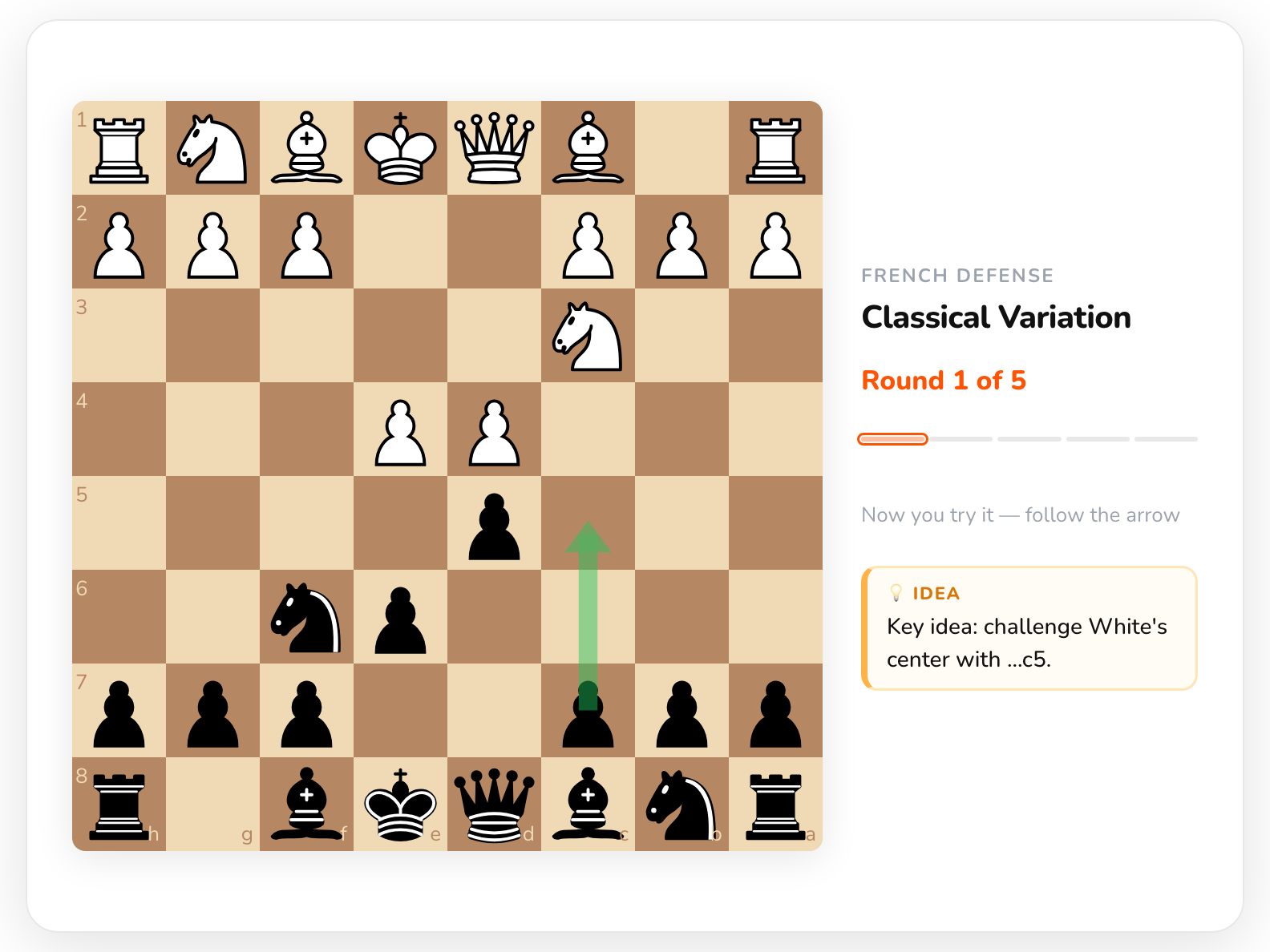
What rating is the French good for?
There is no minimum rating. A beginner can play the French: Chess.com calls it a good choice for players of all levels. The stronger you get, the deeper it is worth studying the variations and the positions they produce.
Starting out
Opening principles and one idea: develop, castle, and do not leave White’s centre alone. The exact moves matter less than that for now.
Building a repertoire
Recognise White’s main replies on sight, and have one clear plan against each of them.
Improving
Learn the plans that belong to each variation, and the positions they keep producing after the opening.
Advanced study
Move orders and concrete theory. Useful later, and a waste of time before the rows above are solid.
The general answer to how many moves to learn is in how many opening moves a beginner should learn.
How much theory do you actually need?
Four steps are enough to start.
Green — your move · Light green — your plan · Red — White’s move · Ring — what you are attacking
Step 1. Recognise the starting position
Black pawns on e6 and d5, White pawns on e4 and d4. This is the picture to know on sight.
Why:Until you recognise the position, you have to invent a plan for it every single game.
Step 2. Understand the strike at the centre
Black pushes the pawn from c7 to c5 and hits White’s pawn on d4. This is the strike the whole opening is built around.
Why:If you understand what the position is aiming at, it is easier to find a move even when your opponent plays a line you never studied.
Step 3. Recognise White’s choice, and your answer to it
Here White has chosen to advance: the pawn went from e4 to e5 and the centre closed. You recognise the picture and already know your answer, the pawn from c7 to c5 against White’s pawn on d4. There are four of these forks in all, and each needs one ready answer like this.
Why:Recognise the position, know the plan. That is the whole first layer of theory, and nothing more is needed to start.
Step 4. Reach your own position from memory
This is the position you are heading for. Getting to it without recalling the move order is the goal.
Why:Understand the idea, train it on the board, then reproduce it with no hints.
How to choose your answer to 1.e4
All four are sound. None of them is the best one, and a beginner who keeps switching in search of the best one learns four openings badly instead of one well. The question worth asking is which kind of game suits you.
Red — White’s move · Green — your reply · Ring — the White pawn you are pressing
Black puts pawns on e6 and d5 and leans on White’s pawn on e4 straight away. The bishop on c8 stays behind its own pawn.
What you get:A clear plan for pressing the centre. What you accept: less space, and an awkward light-squared bishop.
The same pawn on d5 and the same pressure on the e4-pawn, but propped up by the pawn on c6 rather than the one on e6. The bishop on c8 keeps its diagonal.
What you get:The same solidity with the light-squared bishop still free. What you accept: queenside play arrives more slowly.
Black does not go into the centre with a pawn on d5, but fights for it from the side: the pawn on c5 covers d4, and the position stops being symmetrical on move one.
What you get:The sharpest game of the four. What you accept: a great deal more theory.
1…e5 — Open games
For example: Italian GameRuy Lopez
Black puts a pawn straight opposite White’s and brings pieces out at once: the knight from b8 to c6 is already defending the pawn on e5.
What you get:The most natural piece development of the four. What you accept: lines open early, and there are more tactics from the start.
Is this opening right for you?
If you do not know your style yet, that is normal. Play a few short training blocks and see how natural the positions feel to you.
So, should a beginner play it?
Yes, the French Defense suits a beginner. You do not need dozens of variations to start: what matters is the central pawn shape, the strike with the pawn from c7 to c5, and a few typical White replies.
Try it in real games. If the positions make sense to you, go deeper. If you keep wishing you could open the game up and get your pieces moving, compare it with the other answers to 1.e4.
Ready to try the French?
Start with the first layer: the moves, the reason for each one, and the positions they lead to.
Start TrainingWhich French variations to learn first
The same four replies, now in the order worth learning them. Each one has a page of its own: two of the guides are written in full, and the other two carry the position, the main idea and the training while their write-ups are finished.
Red — the move White just played · Light green — what you do about it
Start here. This variation shows most clearly what you are doing in the French: White builds a pawn chain, you attack its base with the pawn from c7 to c5.
The main idea:White’s pawn on d4 is holding the whole chain up, which is why Black goes for that pawn with …c5.
3.Nc3 Nf6 — Classical Variation
Second. Here Black presses the centre with pieces: the knight goes from g8 to f6 and attacks White’s pawn on e4 again.
The main idea:White guarded the e4-pawn with a knight, and Black attacks it a second time straight away.
Third. White’s knight guards the e4-pawn from d2, and it cannot be pinned by a bishop on b4.
The main idea:Black goes straight at White’s pawn on d4 with …c5. With no pin to arrange, the game runs calmer and more direct.
3.exd5 exd5 — Exchange Variation
And last. You have taken back with the pawn from e6, so the e6-square is clear: the bishop on c8 can come out along the diagonal that just opened, to f5 for instance.
The main idea:That awkward bishop gets its freedom. The position is level, so what decides it from here is active development.
Common questions
Is the French Defense good for beginners?
Yes. It is a sound opening that does not need long variations to get started. In return you have to get used to having less space, and learn to switch from developing to attacking White’s centre at the right moment.
Is it difficult to learn?
It is easy to start. Playing it well takes practice, but the difficulty is not the number of moves: it is sensing when to stop developing and start fighting for the centre.
How much theory do you need at the start?
Not much. Understand the starting pawn shape, know how Black presses White’s centre, and have one simple plan against each of White’s main replies. Long variations are not needed at this stage.
What do you do with the light-squared bishop?
Do not rush it. That bishop sits behind one of your own pawns, and dragging it out at any cost is not worth it. It usually takes a step to the side and waits: either the diagonal opens by itself, or a chance to trade it appears.
When should you play c5?
As soon as White has committed in the centre. It is Black’s main way of fighting White’s centre, and putting it off for long is usually a mistake.
What should you learn first?
The line where White pushes the central pawn forward and closes the centre. It shows the point of the opening more clearly than any other: White builds a pawn chain, and you attack its base.